
Roth Conversions Before Retirement: The Window Most People Miss
Retiring and turning 73 bookend your lowest-tax window. Here's how Roth conversions work, and the trap most married couples never see coming.
Roth Conversions Before Retirement: The Window Most People Miss
The short answer
A Roth conversion moves money from a traditional IRA or 401(k) into a Roth IRA. You pay income tax on the amount you convert in the year you convert it. In exchange, that money grows tax-free from then on, comes out tax-free in retirement, and is never subject to required minimum distributions.
The strategy hinges on one question: is your tax rate lower now than it will be later?
For a lot of people, the answer is yes during a specific window — after you stop working, but before Social Security and RMDs start. Your income drops, your bracket drops with it, and for a few years you have more control over your tax rate than at any other point in your life.
That window doesn't stay open. This post explains how to use it.
Why the gap years matter
Think about what your taxable income looks like in the years right after you retire.
Your paycheck has stopped. Social Security may not have started yet — if you're delaying to 70, that's several years of nothing. RMDs don't begin until 73. If you have a pension, it's probably modest relative to what you were earning.
For those few years, your income is unusually low. And low income means low tax rates.
Then it all arrives at once. Social Security starts. RMDs start, and they grow every year as a percentage of your account. Suddenly you have more taxable income than you've had since you were working, and you have very little control over it — RMDs are required whether you need the money or not.
The gap years are the last time you get to choose your tax rate. Conversions are how you use that choice.
The three buckets
A useful way to look at your retirement savings is by how each dollar gets taxed.
Taxable — brokerage accounts, savings, CDs. You pay tax on interest, dividends, and gains as they occur. These generate 1099s every year whether you touch the account or not.
Tax-deferred — traditional IRAs, 401(k)s, 403(b)s. You got a deduction going in. Everything that comes out is ordinary income, and starting at 73, some of it has to come out.
Tax-free — Roth IRAs and Roth 401(k)s. Taxed on the way in, then never again. No RMDs during your lifetime.
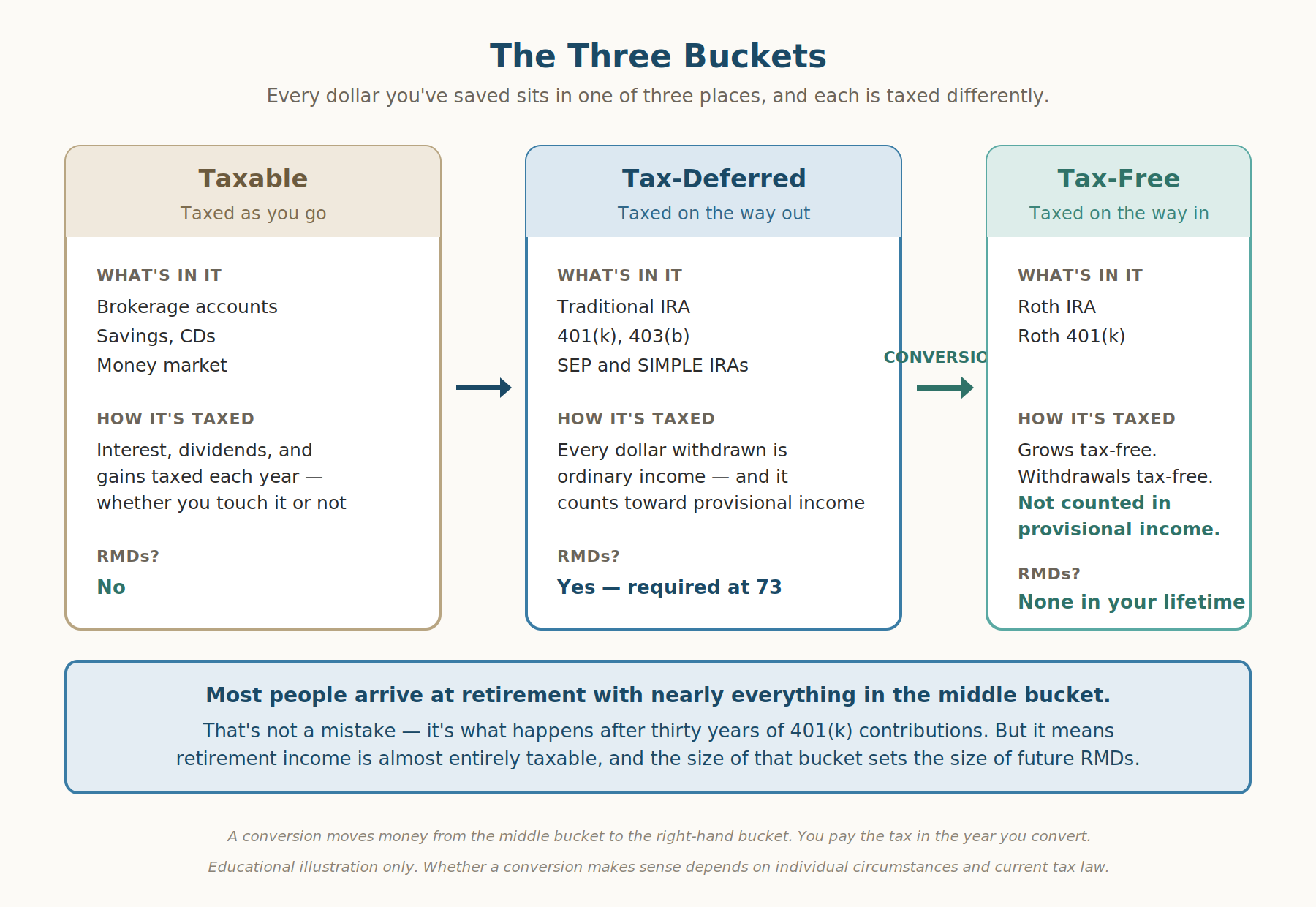
Most people arrive at retirement with almost everything in the middle bucket. That's not a mistake — it's what happens when you contribute to a 401(k) for thirty years. But it means your retirement income is almost entirely taxable, and the size of that bucket determines the size of your future RMDs.
A conversion moves money from the middle bucket to the third one.
An example: Tom and Alice
Here's a scenario I use in Retirement Wealth Academy classes. Both are 69, married filing jointly, retired.
Their income is the same in both versions. Only the source changes.
Without conversion planning
- $60,000 from traditional IRA distributions
- $18,000 from pensions
- $40,000 in Social Security benefits
- Total: $118,000
Because their IRA withdrawals and pension push their provisional income to $98,000, 85% of their Social Security becomes taxable — $34,000 of it. Their adjusted gross income is $112,000, their taxable income is $65,300, and they owe approximately $7,359 in federal income tax.
With conversion planning
Same lifestyle, same money coming in. But in earlier years they converted a portion of the IRA to Roth, so now:
- $54,000 from Roth distributions (not taxable, and not counted in provisional income)
- $18,000 from pensions
- $40,000 in Social Security benefits
- Total: $112,000
Now their provisional income is $38,000 — under the threshold where most Social Security gets taxed. Only $3,000 of their Social Security is taxable. Their adjusted gross income is $21,000, which is less than their deductions. Their taxable income is zero, and they owe no federal income tax.
What "0%" actually means
A marginal rate is the tax on your next dollar of income — not an average. Saying Tom and Alice are at 0% means one more dollar withdrawn this year would be taxed at zero.
It doesn't mean they never pay tax again. It describes one year, with one set of numbers.
And the 0% doesn't run forever even within that year. There's a ceiling — withdraw enough and you cross into the next bracket, and additional income can pull more Social Security into taxable territory too.
Knowing you're at 0% is useful. Knowing how much room is left before that changes is what drives the decision.
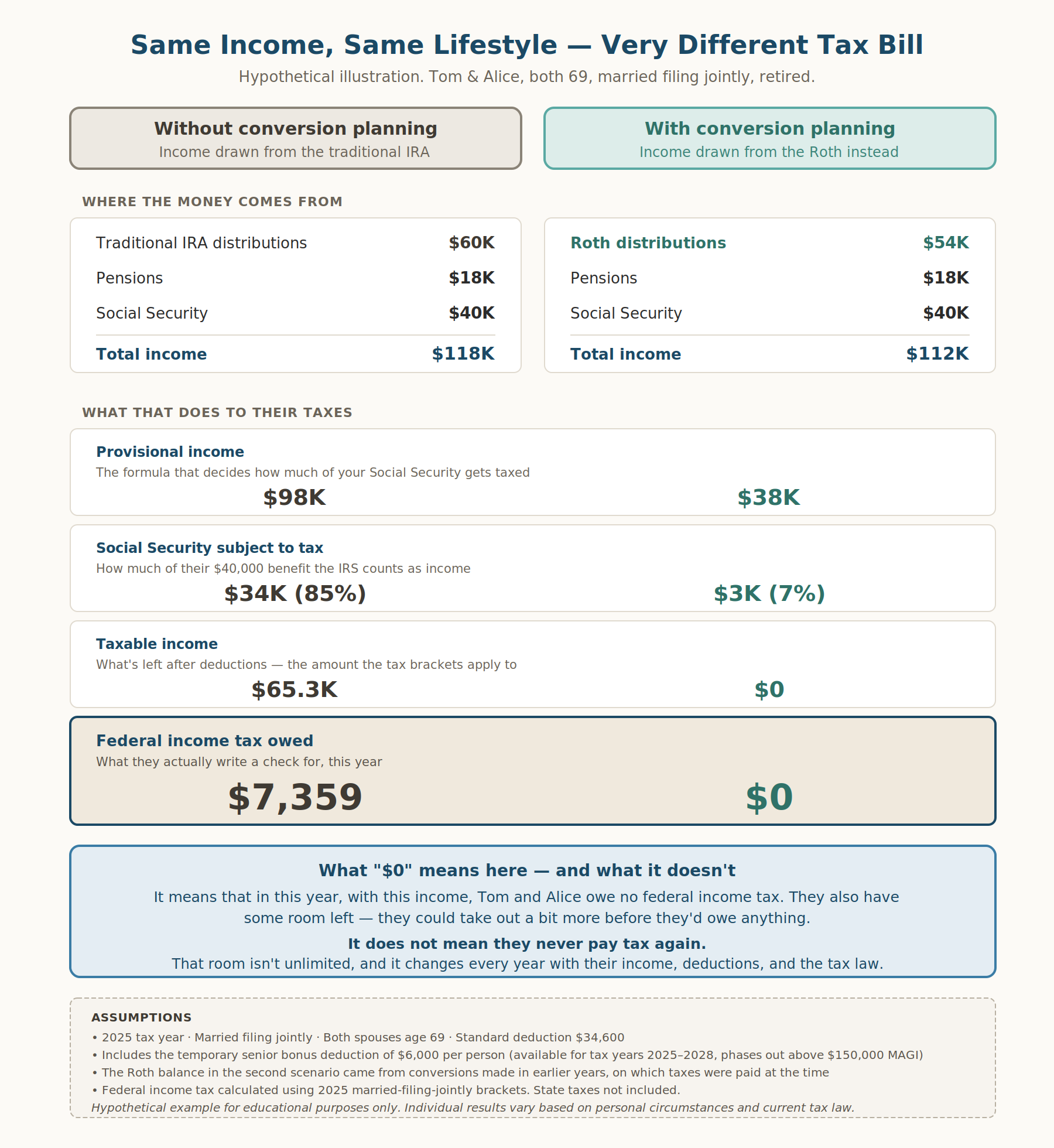
The mechanism is worth understanding: Roth withdrawals don't count toward provisional income. That's the formula that determines how much of your Social Security gets taxed, which I covered in detail in our Social Security guide. Changing where the money comes from changed how much of their Social Security was exposed.
The part most married couples never consider
Here's something that comes up in nearly every class, and almost nobody has thought about it.
When one spouse dies, the survivor files as a single taxpayer.
Single brackets are roughly half as wide as married-filing-jointly brackets. The standard deduction is roughly half. The provisional income thresholds that determine Social Security taxation are lower for singles too — $25,000 and $34,000, versus $32,000 and $44,000 for couples.
Meanwhile, the surviving spouse typically keeps most of the household's assets. The IRA is still there. The RMDs are still required, and they're calculated on a balance that hasn't shrunk. The survivor keeps the higher of the two Social Security benefits.
So: roughly the same taxable income, run through a much less forgiving tax structure.
This is sometimes called the widow's penalty, and it lands during one of the hardest years of someone's life. A surviving spouse can find themselves paying noticeably more in tax on similar income, at exactly the moment they're least equipped to deal with it.
Conversions done while both spouses are alive — while the wider married brackets are still available — reduce the tax-deferred balance the survivor inherits. It's one of the most overlooked reasons to convert, and one of the most humane.
When conversions don't make sense
Conversions get sold as universally good. They aren't. Real reasons to slow down or skip:
You'd have to pay the tax from the IRA itself. Paying conversion tax with converted dollars shrinks what actually reaches the Roth, and defeats much of the point. The tax should come from cash or a taxable account. If it can't, the math weakens considerably.
You're pushing into a higher bracket. Converting an amount that jumps you from 12% to 22% may cost more than it saves. The size of the conversion matters as much as the decision to convert.
You're on Medicare and near an IRMAA threshold. A conversion adds to your modified adjusted gross income. Cross certain thresholds and you'll pay Medicare Part B and D surcharges — for two years afterward. A conversion that looks good on paper can be erased by IRMAA.
You'd phase out of the senior deduction. If you're 65 or older, you may qualify for a temporary bonus deduction of up to $6,000 per person, available for tax years 2025 through 2028. It begins phasing out above $150,000 of modified adjusted gross income for joint filers. Because a conversion increases MAGI, a large one can reduce or eliminate this deduction.
You're leaving the IRA to charity. A charity pays no tax on an inherited traditional IRA. Converting first means you paid tax on money that would have transferred tax-free.
Your heirs will be in lower brackets than you. Then the deferral may be worth more to them than the conversion is to you.
It's irreversible. Recharacterizations were eliminated in 2017. Once you convert, you can't undo it — so this shouldn't involve money you might need within five years.
What this means for your plan
A few principles I come back to in class:
1. The window is finite. Every year between retirement and 73 that passes without a conversion is a year you don't get back.
2. The amount matters as much as the decision. Filling a low bracket is the goal — not converting as much as possible.
3. Your bracket isn't your real tax rate. Because conversions can push more of your Social Security into taxable territory, the effective rate on a converted dollar is often higher than the bracket suggests. This is why it needs to be modeled, not estimated.
4. Look at it across decades, not one tax year. A conversion that costs you this April can save considerably more over twenty-five years.
5. Coordinate it with everything else. Social Security timing, RMD planning, Medicare premiums, and your estate goals all interact here. Handled in isolation, a conversion can solve one problem and create another.
The bottom line
Roth conversions aren't about avoiding taxes. They're about choosing when to pay them.
For many retirees, the years between leaving work and turning 73 are the lowest-rate window they'll ever have, and the only stretch where they genuinely control their tax rate. Used well, that window can reduce the taxes on your Social Security, shrink your future RMDs, and leave a surviving spouse in a far better position.
Used carelessly — converting too much, in the wrong year, with the tax paid from the wrong account — it can cost more than it saves.
The difference is analysis. If you'd like to see what this window looks like in your own situation, that's the kind of work we do at Hartman Retirement Partners.
What is a Roth conversion?
Moving money from a tax-deferred account (traditional IRA, 401(k)) into a Roth IRA. You pay income tax on the converted amount in that year. After that, the money grows tax-free, withdrawals are tax-free, and it's not subject to RMDs.
When is the best time to do a Roth conversion?
Usually the years between when you retire and when Social Security and RMDs begin, because that's typically when your taxable income and your tax rate are lowest.
How much should I convert?
Enough to fill your current bracket without spilling into the next one — and without crossing an IRMAA threshold if you're on Medicare. The right number changes each year with your income.
Do I have to pay taxes on a Roth conversion?
Yes. The converted amount is ordinary income in the year you convert. Ideally you pay that tax from cash or a taxable account rather than from the IRA.
Can I undo a Roth conversion?
No. Recharacterizations were eliminated by the 2017 tax law. Conversions are permanent, which is why sizing them correctly matters.
Do Roth withdrawals affect taxes on my Social Security?
No — and that's a large part of their value. Roth withdrawals aren't included in the provisional income formula that determines how much of your Social Security is taxable.
Is there a deadline?
December 31 of the tax year. Unlike IRA contributions, there's no prior-year option — a conversion for 2026 must be completed by the end of 2026.