
Medicare · IRMAA · Tax Planning · Roth Conversions · Social Security
One Dollar Over: The Medicare Surcharge That Surprises Retirees
Medicare premiums are set by your income from two years ago. See how IRMAA works, how one dollar over a threshold can cost thousands, and how to plan for it.
Dave and Linda (a hypothetical couple) converted $14,000 from their IRA to a Roth. The last $1,000 of that conversion cost them about $2,297 in extra Medicare premiums.
They didn't do anything wrong. They just didn't know about IRMAA.
The short answer
Once you're on Medicare, your premiums depend on your income. Above certain levels, you pay a surcharge called IRMAA, the Income-Related Monthly Adjustment Amount.
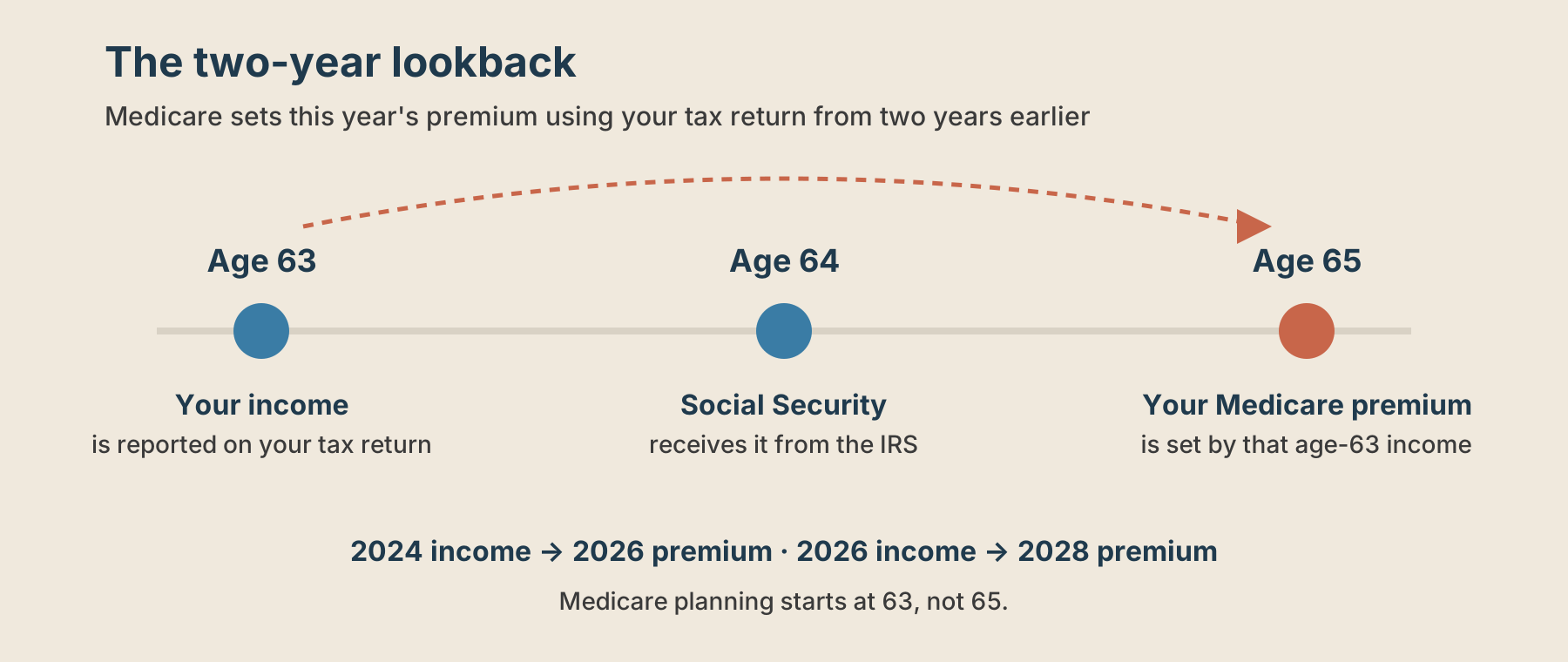
The catch: Medicare looks at your tax return from two years ago. Your 2026 income sets your 2028 premium. A Roth conversion, a property sale, or a big bonus in your early sixties can raise your Medicare bill years later.
IRMAA isn't something to fear. It's something to plan around.
What Medicare costs in 2026
The standard Part B premium is $202.90 a month. IRMAA adds a surcharge to Part B and to Part D (prescription drugs) once your income passes $109,000 single or $218,000 joint. It applies with Original Medicare or Medicare Advantage.
The standard Part B premium is $202.90 a month. IRMAA adds a surcharge to Part B and to Part D (prescription drugs) once your income passes $109,000 single or $218,000 joint. It applies with Original Medicare or Medicare Advantage.
| 2024 income (MAGI), single | 2024 income (MAGI), married filing jointly | Monthly Part B premium, per person | Part D surcharge, per person |
|---|---|---|---|
| $109,000 or less | $218,000 or less | $202.90 | $0 |
| $109,001 – $137,000 | $218,001 – $274,000 | $284.10 | $14.50 |
| $137,001 – $171,000 | $274,001 – $342,000 | $405.80 | $37.50 |
| $171,001 – $205,000 | $342,001 – $410,000 | $527.50 | $60.40 |
| $205,001 – $499,999 | $410,001 – $749,999 | $649.20 | $83.30 |
| $500,000 or more | $750,000 or more | $689.90 | $91.00 |
Source: CMS, 2026 Medicare Parts A & B Premiums and Deductibles. The Part D surcharge is added to whatever your drug plan already charges.
Note that the premiums are per person. A married couple both on Medicare each pays the surcharge, based on their joint income.
The two-year lookback
Social Security uses the most recent tax return the IRS has on file, which is usually two years old.
That means Medicare planning starts at 63, not 65. The income you report at 63 sets your premium when coverage begins at 65.
It also means your first Medicare bill may reflect a paycheck you no longer have. More on fixing that below.
How one dollar can cost thousands
Tax brackets are gradual: only the dollars above the line are taxed at the higher rate. IRMAA isn't. Go one dollar over a threshold and you pay that tier's full surcharge for the whole year.
Back to Dave and Linda. They're both 66 and on Medicare, with about $205,000 of income. A $14,000 Roth conversion takes them to $219,000, $1,000 over the $218,000 line.
| Convert $13,000 | Convert $14,000 | |
|---|---|---|
| Income (MAGI) | $218,000 | $219,000 |
| Part B premium, per person | $202.90/mo | $284.10/mo |
| Part D surcharge, per person | $0 | $14.50/mo |
| Extra Medicare cost for the year, both spouses | $0 | about $2,297 |
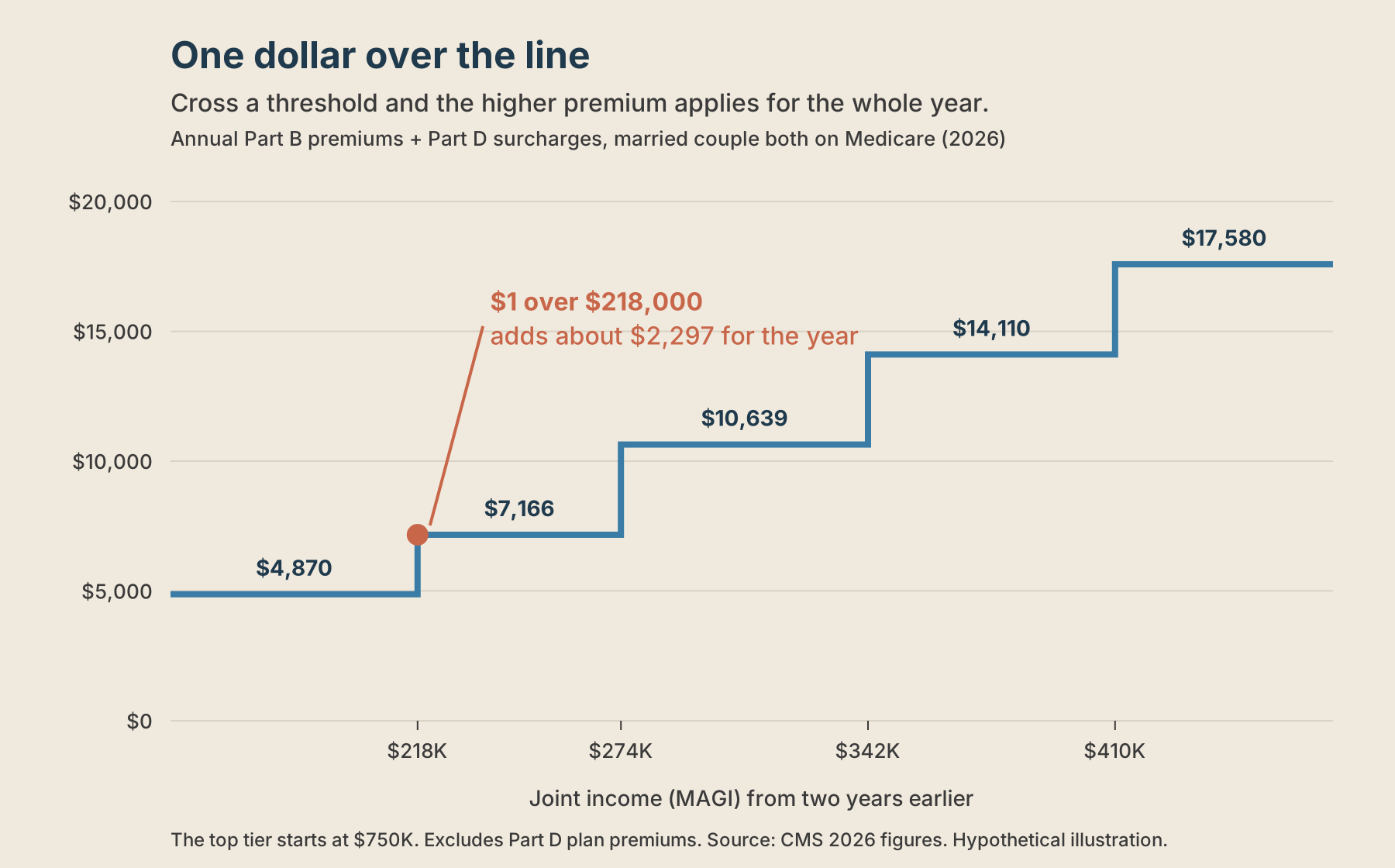
The fix wasn't skipping the conversion. It was converting a little less this year and the rest next year. (In practice, you'd leave a cushion below the line.)
Sometimes crossing a line is worth it for the long-term tax savings. Just make that choice on purpose, not by surprise.
What counts as income for IRMAA
Medicare uses your modified adjusted gross income: your adjusted gross income plus any tax-exempt interest. Yes, municipal bond interest counts, even though it isn't taxed.
Counts: wages, pensions, the taxable part of Social Security, IRA and 401(k) withdrawals, RMDs, Roth conversions, interest, dividends, and capital gains — including a gain on a home sale above the exclusion.
Doesn't count: qualified Roth IRA withdrawals, HSA withdrawals for medical expenses, and qualified charitable distributions (QCDs) from an IRA.
The thresholds are adjusted for inflation most years, so the numbers that apply to this year's income won't be known until later. Plan with a cushion, not to the dollar.
Five things that can push you over the line
- Roth conversions. Every converted dollar counts. Size conversions to the IRMAA lines, not just the tax brackets. (Our Roth conversion post)
- Social Security. Up to 85% of your benefit can count as income, and when you claim matters. (Our Social Security post)
- RMDs. They start at 73, grow each year, and aren't optional.
- One big sale. A rental, a business, or a large stock position can create a single high-income year.
- Losing a spouse. The survivor eventually files single, at half the thresholds, but usually keeps well over half the income.
Can I appeal if I just retired?
Often, yes. If your income dropped because of a life-changing event, you can ask Social Security to use your current income instead, using Form SSA-44. Qualifying events include:
- Stopping work or cutting back your hours
- Marriage, divorce, or the death of a spouse
- Losing a pension or income-producing property
A Roth conversion or a one-time gain doesn't qualify. Those were your choice, which is why they're worth planning ahead.
What to do before December 31
Open Enrollment (October 15 to December 7) gets the attention. But for many retirees, the bigger lever is income, and the tax year closes December 31. Ask yourself:
- Where will my income land this year, and how close is it to a line?
- Am I planning a Roth conversion or a big sale? Can I size or time it around the thresholds?
- Did I stop working recently? An SSA-44 appeal may lower my premium now.
Want to know how close you are to the line? Request an IRMAA check. We'll map your income for this year and the next two, and show you where the lines are before you cross them.
We don't sell Medicare plans. For help choosing coverage, we're happy to refer you to a licensed Medicare specialist.
Disclosure:
Dave and Linda are a hypothetical example and do not represent actual clients. Medicare premiums and IRMAA thresholds shown are 2026 amounts set by CMS and the Social Security Administration and change each year. This material is for educational purposes only and is not tax, legal, or individualized investment advice. Consult a qualified tax professional about your situation. Advisory services offered through Brookstone Capital Management, LLC, a registered investment adviser.
Does IRMAA apply if I have Medicare Advantage?
Yes. Everyone pays the Part B premium, including Medicare Advantage members, so the surcharge applies either way.
Is IRMAA permanent once I'm in a higher tier?
No. It's recalculated every year from your income two years earlier. One high-income year affects one year of premiums.
I'm still working and have employer coverage. Does IRMAA apply to me?
Only once you enroll in Medicare Part B or Part D. If you delay enrollment because of employer coverage, there's no premium to adjust yet.
Does filing married-separately help?
Usually not. If you lived with your spouse during the year and file separately, the thresholds are much lower: anything over $109,000 puts you in the second-highest tier.
Do qualified charitable distributions (QCDs) lower my IRMAA income?
Yes. A QCD from an IRA goes straight to charity and isn't counted in your adjusted gross income, so it can satisfy giving goals without raising your Medicare premium.
What if Social Security used the wrong income?
If the tax return they used was later amended, or the figure is simply wrong, you can ask Social Security for a new determination with the correct information.