
Business Owners · Business Value · Retirement Income · Tax Planning
Is Your Business Your Retirement Plan?
What is your business really worth? Learn what drives its value, and why it matters for your retirement even if you never sell.
For many owners, the business is the retirement plan. It's where the time, the money, and the years went, and it's often 80% or more of everything they own.
That makes one question more important than most owners realize: what is it actually worth?
Most owners know their numbers cold: revenue, margins, payroll, what the slow month looks like. Ask what the business itself is worth, though, and you'll often get a shrug or a guess.
The short answer
Your business has a value apart from the income it pays you. Professionals call it enterprise value: what a qualified buyer would pay for the business as a going concern.
It's usually figured as a multiple of adjusted profit, what valuation professionals call EBITDA. Profit is what you earn. The multiple is how much a buyer trusts that profit to keep coming without you. That's the part most owners can change, and it's where the biggest gains usually are.
This isn't only a question for owners who want to sell. A business that's worth more is one that's stronger, less dependent on you, and gives you more choices about what comes next. In a 2026 national survey of more than 1,100 business owners, fewer than 1 in 5 had ever paid for a professional valuation.
Same profit, very different value
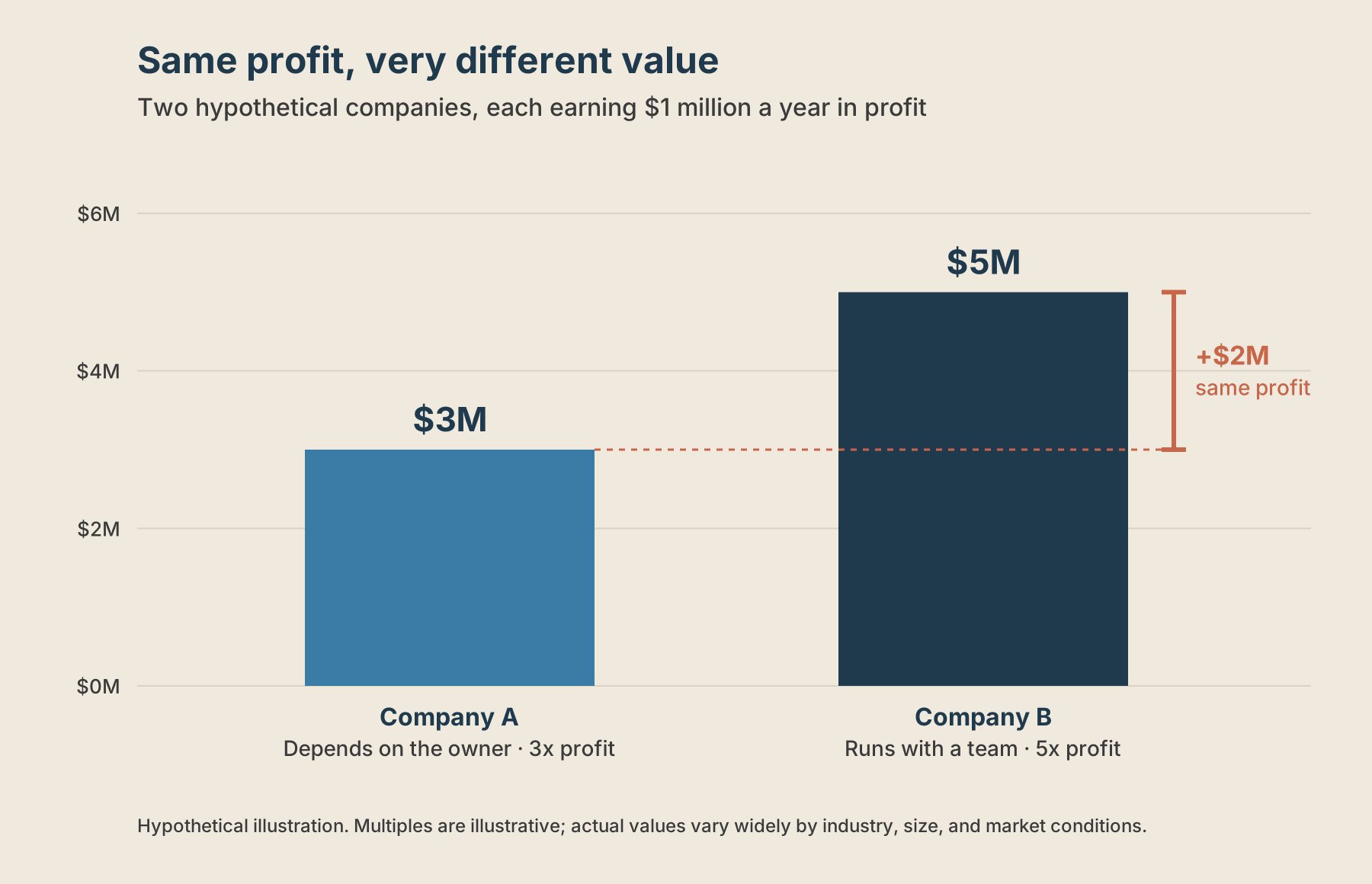
Picture two hypothetical companies in the same industry. Each earns $1 million a year in profit for its owner.
| What's different | Company A | Company B |
|---|---|---|
| Annual profit (EBITDA) | $1,000,000 | $1,000,000 |
| Who the customers call | The owner | The team |
| Biggest customer | 35% of revenue | 8% of revenue |
| Revenue | Mostly one-time projects | Mostly service contracts |
| Owner's time off | A long weekend, with the phone on | A month, without checking in |
| Illustrative multiple | 3x profit | 5x profit |
| Enterprise value | $3 million | $5 million |
Same profit. A $2 million difference in value. Nothing about Company B is magic. Its owner spent a few years making the business less dependent on them, and a buyer pays for that.
The same changes that raise the multiple also make the business easier to run day to day. That's the enterprise value play: you're not preparing to leave, you're building something stronger.
Your biggest investment, and your least diversified
You'd probably never put 80% of your savings into one stock. But that's the position many owners are in, with one difference: you can't easily or immediately sell a slice of your business when you need cash.
That's not a reason to love the business less. It's a reason to build wealth beside it, too:
- Take some chips off the table. Savings outside the business protect you if your industry hits a rough patch, the same way a balanced portfolio helps in a market downturn.
- Use the tax tools owners have. Business owners often have access to retirement plans with much higher contribution limits than employees do, and some can be built to add Roth savings. Our Roth conversion post covers why tax-free money matters later.
- Know the number. A valuation tells you how much of your net worth is really tied up in the business, and how much you'd need outside it to feel secure.
Do you own the business, or does the business own you?
Three questions to ask yourself:
- If you took four weeks off with no calls or emails, how would the business do?
- How much of your know-how is written down, and how much lives in your head?
- If something happened to you tomorrow, who would step in and lead?
These are the same questions a buyer asks. The more confident your answers, the higher the multiple. Customers spread across many accounts, recurring revenue, and clean financials help too. Each takes a year or more to build, which is why it pays to start early, whatever your plans.
Not sure how you'd answer those? That's exactly what a complimentary business value review shows.
Whether you sell in 3 years, 10, or never
For a lot of owners, the business isn't just an asset. It's who they are. Nobody's asking you to stop. But someday you'll step back, whether by choice or not, and a more valuable business earns more now and gives you more options later when you:
- Sell to an outside buyer
- Pass it to family, or to your team
- Step back from day-to-day work and keep the income
That "or not" matters more than most owners think. In Walking to Destiny, Christopher Snider notes that nearly half of business transitions are involuntary, often triggered by what planners call the 5 D's: death, disability, divorce, disagreement among partners, and distress. Building value now is also how you prepare for a day you don't get to choose.
Whichever path you choose, the transition years have their own planning questions:
- Taxes on a sale. How a deal is structured, and when you get paid, can change how much you keep. Your tax advisor and attorney belong in that conversation early.
- Medicare. A big income year after 63 can raise your Medicare premiums two years later. See our post on the Medicare surcharge.
- Social Security. When you step back changes when it makes sense to claim. See our post on when to claim Social Security.
- The lower-income years. Once the business income slows, there may be a window for Roth conversions before required distributions begin.
Where to start
You don't need a plan to sell. You need three numbers:
- What your business is worth today, based on a real valuation, not a rule of thumb.
- What's driving that number, and which changes would raise it the most.
- When work becomes optional: how much of your net worth the business is, and what it would take to reach the point where working is a choice, not a requirement.
With those in hand, every decision gets clearer, from who to hire next to how much to put away this year.
I work with business owners in Utah, Nevada, and California who want the business they've built to fund the life they've earned. A complimentary business value review is a simple way to start:
- A short conversation about your business, your goals, and what you want the next chapter to look like.
- An estimate of your business's value, based on one to three years of financial information, and what's driving the number.
- A review of the results together: what moves the value most, and what it means for your retirement plan.
Curious what your business is really worth? Request a complimentary business value review. No cost, no obligation.
About the author
Hartman Andersen is a Certified Exit Planning Advisor (CEPA®) and the advisor behind Hartman Retirement Partners. He has been a financial advisor since 2015 and helps business owners and pre-retirees connect the value of what they've built to the retirement they want.
Disclosure:
Company A and Company B are hypothetical examples and do not represent actual clients or businesses. Multiples and values are illustrative; actual business values vary widely by industry, size, and market conditions. Survey figures are from a 2026 survey of 1,104 U.S. business owners sponsored by Exit Factor and conducted by Researchscape International, and from the Exit Planning Institute's 2023 National State of Owner Readiness Report. The involuntary-transition figure is from Christopher Snider, Walking to Destiny. This material is for educational purposes only and is not tax, legal, or individualized investment advice. Consult qualified tax and legal professionals about your situation. Advisory services offered through Brookstone Capital Management, LLC, a registered investment adviser.
Why should I care what my business is worth if I'm not selling?
Because it's likely your largest asset, and its value affects your retirement, your estate plan, your insurance needs, and any future deal with a partner or family member. It's also a scorecard: the things that raise value tend to make the business easier to run.
What is EBITDA, and what does "adjusted" mean?
EBITDA stands for earnings before interest, taxes, depreciation, and amortization. It measures what the business itself earns, apart from how it's financed or taxed. "Adjusted" means it's been cleaned up for things a buyer wouldn't inherit, like personal expenses run through the business or an owner's pay that's above or below market. Those adjustments can move the number a lot, in either direction.
Is a rule-of-thumb valuation good enough?
It's a starting point, but industry rules of thumb can be off by a wide margin for your specific business. A formal valuation shows what drives your number and what would move it.
How long does it take to raise the value of the business?
It depends on what's holding it back. Some changes, like cleaning up financial records, take months. Others, like building a team that can run things without you, usually take a few years.
What if I want to pass the business to family or my team?
Value still matters. It sets the price, the taxes, and often how the deal gets financed, which frequently means the owner is paid over time. That ties your retirement income to how well the business does after you step back.
Who should be involved in valuing and growing my business?
Usually a small team: a valuation professional, your CPA, a business attorney, and a financial advisor who connects the business to your personal plan. The point is that they work from the same numbers instead of in separate silos.